

PRODUCTS
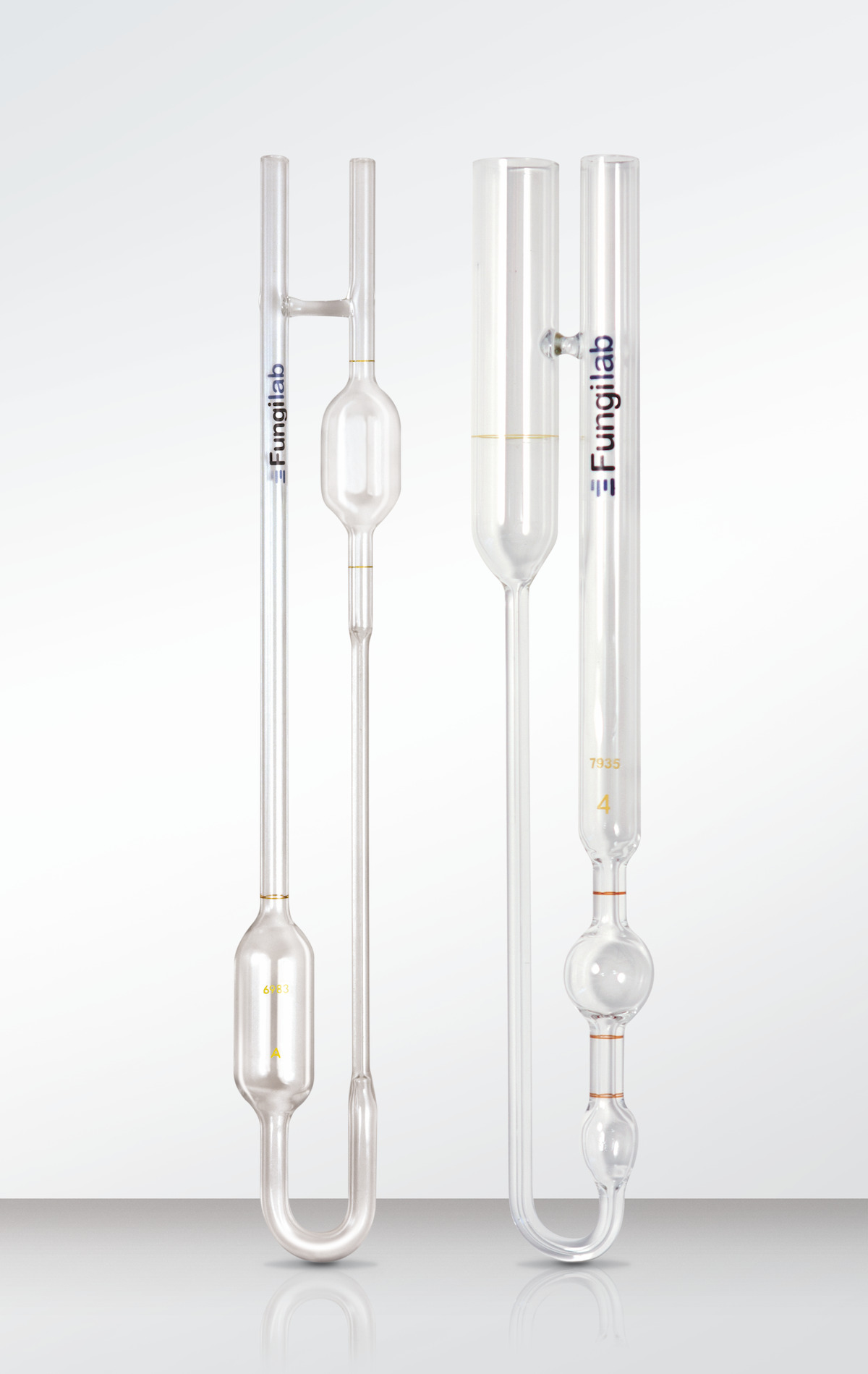
BS U-Tube viscometers for opaque liquids
BS U-Tube viscometers for opaque liquids
BS U-Tube viscometers for opaque liquids are designed for accurate and repeatable kinematic viscosity measurements when the sample cannot be clearly observed through a conventional capillary viscometer.
The reverse-flow configuration allows dark, coloured and opaque Newtonian liquids to be measured reliably in laboratory, quality control and industrial testing applications.
Fungilab BS/IP/RF U-Tube viscometers are manufactured from borosilicate glass and comply with internationally recognised ASTM, ISO and UNE testing standards.
Our products
Kinematic Viscometer Types
BS/U-Tube & BS/IP/RF U-Tube
BS/U-TUBE VISCOMETERS FOR TRANSPARENT LIQUIDS
BS/U-Tube Viscometers for Transparent Liquids
BS, ASTM D-445, D446, ISO 3104, ISO 3105 and UNE 400313
Made of borosilicate glass, and non-alterable timing marks. With constant value at 40ºC and 100ºC into the calibration certificate. Precision: ±0.2%.
BS/IP/RF U-TUBE REVERSE FLOW VISCOMETERS FOR OPAQUE LIQUIDS
BS/IP/RF U-Tube Reverse Flow Viscometers for Opaque Liquids
BS-IP-RF, ASTM D-445, D446, ISO 3104, ISO 3105 and UNE 400313
Made of borosilicate glass, and non-alterable timing marks. With constant value at 40ºC and 100ºC into the calibration certificate.
Precision: ±0.3%.
All capillary viscometers are supplied with the calibration certificate issued in accordance with the conditions of accreditation granted by a National Metrological Register which has assessed the measurement capability of the laboratory, the test uncertainty and its traceability to recognized international standards UKAS.
Accessories
Today’s business world brings new challenges that demand innovative solutions. Fungilab’s aim, as a leading viscosity technology company, is to become an expertise partner in the viscosity world to offer you our best products and services.
To provide you and your customers with this necessary attention and an expertise support, Fungilab offers a wide range of products for the measuring of the kinematic viscosity of your products.
Our kinematic series include: the Höppler viscometer (falling ball), for the measurement of the low viscosity liquids in all industries; capillary viscometer series and baths, in accordance to ASTM and DIN methods, to obtain the most accurate viscosity of your liquids; and flow cup viscometers, suitable for paints, inks, varnishes and similar products.
Kinematic viscosity is a measure of a fluid’s resistance to flow under the influence of gravity. It’s defined as the ratio of the fluid’s dynamic (absolute) viscosity to its density. In other words, it describes how thick or thin a fluid is without the involvement of any external force except gravity.
Reverse-flow capillary viscometers for opaque samples
The BS/IP/RF U-Tube reverse-flow viscometer is specifically designed for measuring the kinematic viscosity of opaque Newtonian liquids. Its measuring configuration makes it possible to determine flow time without relying on the same visual conditions required by conventional capillary viscometers for transparent samples.
This makes the instrument suitable for dark petroleum products, lubricants, oils, chemical products and other samples where colour or opacity can make standard viscosity measurement difficult.
Standards for BS U-Tube viscosity testing
Fungilab BS U-Tube viscometers for opaque liquids are manufactured according to recognised viscosity testing procedures, including:
- ASTM D445
- ASTM D446
- ISO 3104
- ISO 3105
- UNE 400313
Main characteristics
- Reverse-flow configuration for opaque liquids.
- Borosilicate glass construction.
- Permanent and non-alterable timing marks.
- Measurement precision of approximately ±0.3%.
- Calibration certificate with constant values at 40°C and 100°C.
- Suitable for laboratory and industrial quality control.
Calibration and measurement traceability
Each capillary viscometer is supplied with an individual calibration certificate issued under the accreditation requirements of a National Metrological Register. This documentation supports measurement traceability, laboratory capability and uncertainty evaluation according to recognised international standards.
Accurate kinematic viscosity measurement also requires stable sample temperature. The Fungilab Thermocap precision bath provides controlled conditions for measurements performed with glass capillary viscometers.
BS U-Tube viscometers for transparent and opaque liquids
Fungilab offers BS U-Tube capillary viscometers for both transparent and opaque samples. Standard BS U-Tube models are intended for transparent Newtonian liquids, while BS/IP/RF reverse-flow models are designed for opaque liquids.
Other available solutions include Cannon-Fenske viscometers and Ubbelohde viscometers for different kinematic viscosity measurement methods and sample requirements.
Applications for opaque liquid viscosity measurement
BS U-Tube reverse-flow viscometers are suitable for viscosity testing in sectors such as petroleum, lubricants, oils and chemicals. They can be used for routine quality control, batch comparison, product verification and laboratory research.
Fungilab can help select the appropriate capillary size and measuring range according to the expected viscosity, sample characteristics, operating temperature and applicable testing standard.
Frequently asked questions about BS U-Tube viscometers for opaque liquids
What is a BS U-Tube viscometer for opaque liquids?
It is a reverse-flow glass capillary viscometer designed to measure the kinematic viscosity of dark, coloured or opaque Newtonian liquids.
Why is a reverse-flow viscometer used for opaque samples?
The reverse-flow configuration allows reliable flow-time measurement when the sample is too dark or opaque for conventional observation methods used with transparent-liquid capillary viscometers.
Which standards apply to BS U-Tube viscometers for opaque liquids?
Fungilab BS/IP/RF U-Tube viscometers are manufactured according to ASTM D445, ASTM D446, ISO 3104, ISO 3105 and UNE 400313.
What measurement precision do these viscometers provide?
The BS/IP/RF U-Tube reverse-flow viscometers for opaque liquids provide a measurement precision of approximately ±0.3%.
Are BS U-Tube viscometers supplied with a calibration certificate?
Yes. Each viscometer is supplied with an individual calibration certificate that includes constant values at 40°C and 100°C and provides traceability to recognised international standards.
Which samples can be measured with a BS U-Tube reverse-flow viscometer?
Typical samples include opaque petroleum products, lubricants, oils, chemicals and other dark Newtonian liquids requiring accurate kinematic viscosity measurement.
Is temperature control necessary during capillary viscosity testing?
Yes. Kinematic viscosity is strongly affected by temperature, so measurements should be performed under stable and controlled thermal conditions using a suitable precision bath.
What is the difference between BS U-Tube models for transparent and opaque liquids?
Standard BS U-Tube models are designed for transparent Newtonian liquids, while BS/IP/RF reverse-flow models are specifically intended for opaque liquids.
