

PRODUCTS
Kinematic viscosity
Our products
Kinematic Viscometer Types
UBBELOHDE (ASTM & DIN)
UBBELOHDE (ASTM & DIN)
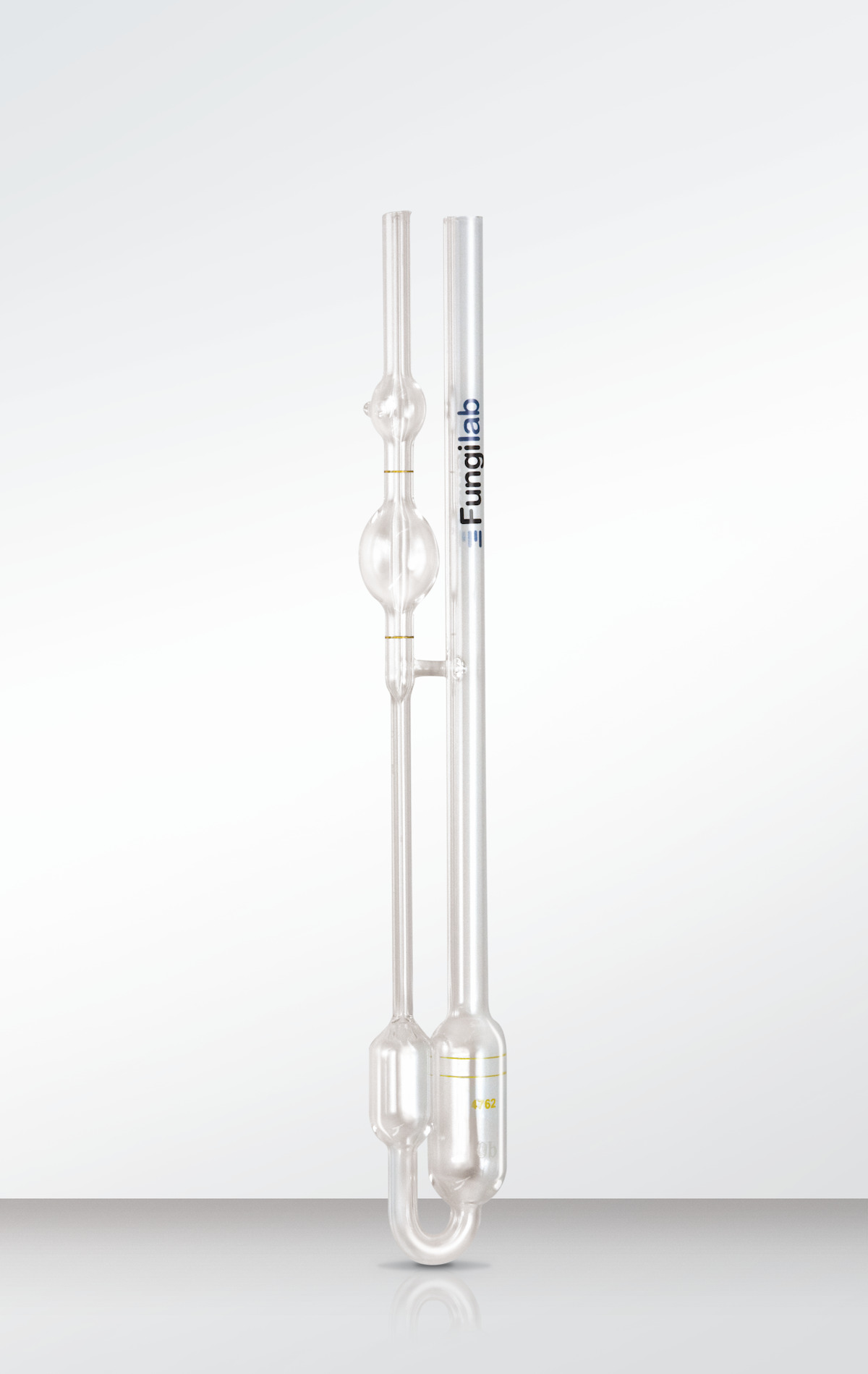
These FUNGILAB glass capillary viscometers allow measurement of viscosities using ASTM and DIN testing methods. All capillary viscometers are supplied with the calibration certificate issued in accordance with the conditions of accreditation granted by a National Metrological Register which has assessed the measurement capability of the laboratory, the test uncertainty and its traceability to recognized international standards UKAS.
UBBELOHDE ASTM (ASTM D445-446, ASTM D2515, ISO 3104-3105 and UNE 400313)
UBBELOHDE DIN (DIN 51562 Part 1, ISO 3105 and UNE 400313)
Ubbelohde Viscometers are used to determine kinematic viscosity of transparent
Newtonian liquids. Sample volume: approx. 15 ml.
Precision: ±0.2%.
* Fungilab offers many types of glass capillary viscometers that are not listed in our catalog. We can also manufacture glass capillary viscometers with customer-specified constants. Viscometers with special constants, added temps, and before/after data are available by special order.
For further information contact Fungilab.
Accessories
Today’s business world brings new challenges that demand innovative solutions. Fungilab’s aim, as a leading viscosity technology company, is to become an expertise partner in the viscosity world to offer you our best products and services.
To provide you and your customers with this necessary attention and an expertise support, Fungilab offers a wide range of products for the measuring of the kinematic viscosity of your products.
Our kinematic series include: the Höppler viscometer (falling ball), for the measurement of the low viscosity liquids in all industries; capillary viscometer series and baths, in accordance to ASTM and DIN methods, to obtain the most accurate viscosity of your liquids; and flow cup viscometers, suitable for paints, inks, varnishes and similar products.
Kinematic viscosity is a measure of a fluid’s resistance to flow under the influence of gravity. It’s defined as the ratio of the fluid’s dynamic (absolute) viscosity to its density. In other words, it describes how thick or thin a fluid is without the involvement of any external force except gravity.
