PRODUCTS
Capillary Viscometer Bath
Dynamic viscosity measurement for laboratory and industrial applications
Dynamic viscosity measurement is essential for evaluating how liquids and semi-solid materials resist flow under applied force. Accurate viscosity data supports product development, quality control and process optimisation across a wide range of industries.
Fungilab provides complete dynamic viscosity measurement solutions based on precision rotational viscometers, temperature control systems and specialized accessories designed to deliver reliable, repeatable and traceable laboratory results.
Whether measuring low-viscosity liquids or highly viscous materials, Fungilab offers instruments adapted to routine laboratory testing as well as demanding research applications.
Our products
Kinematic Viscosity accessories
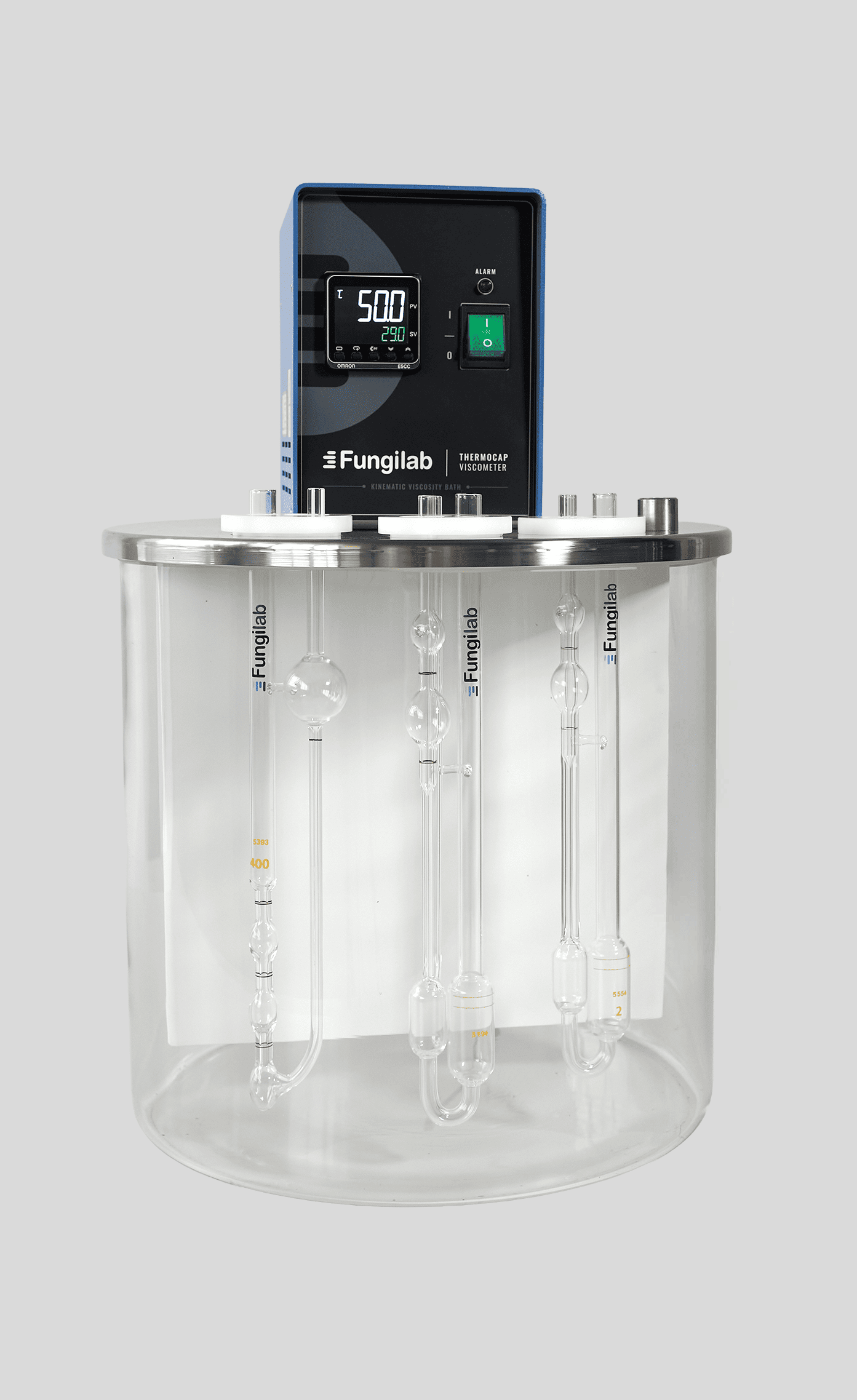
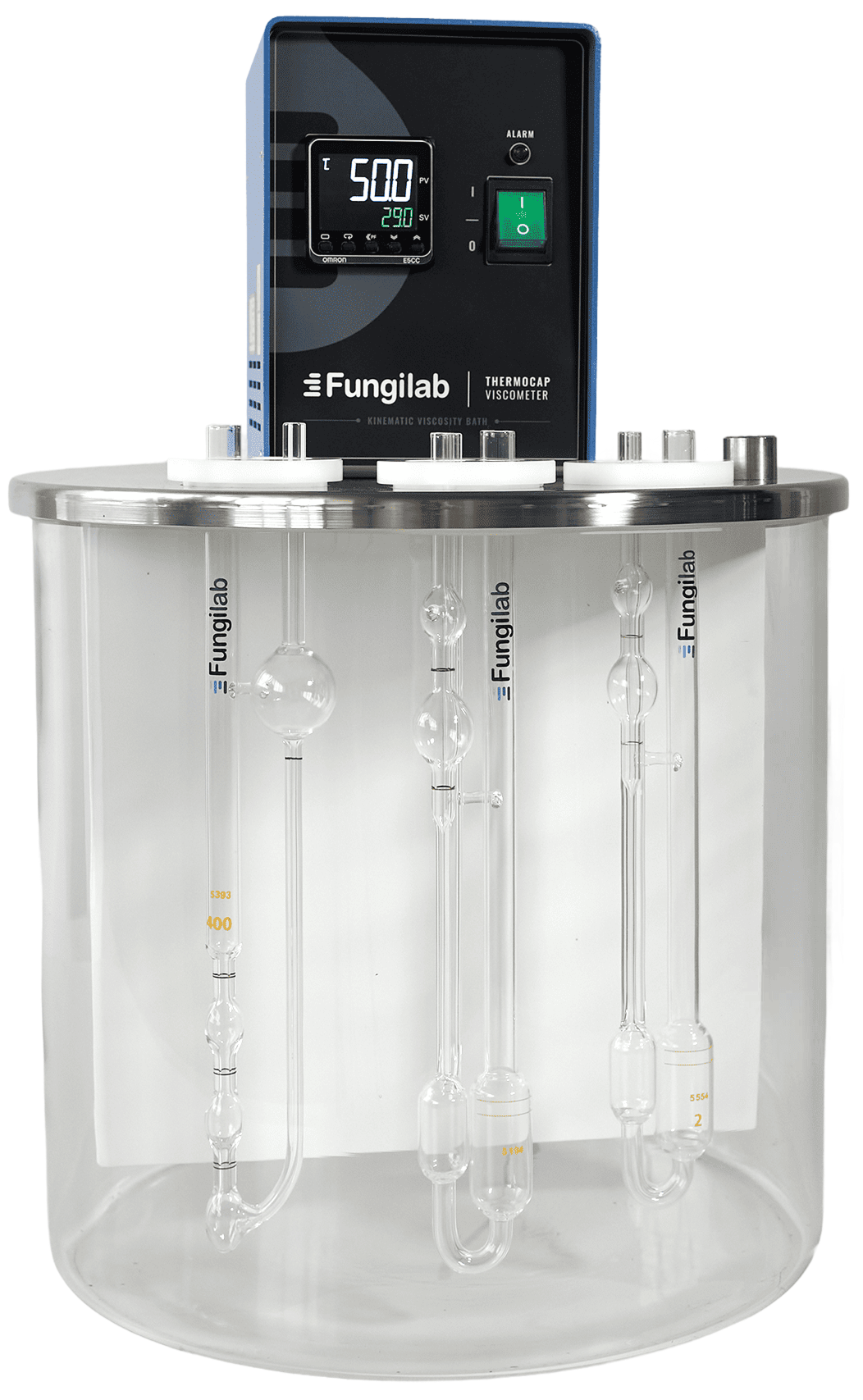
Capillary Viscometer Precision Bath THERMOCAP
FOR CONTROLLABLE TEMPERATURES FROM AMB.+5 °C TO 100 °C.
Used for measurements with glass viscometers
Made for the calibration of viscometers according to the following standards UNE 400313, ISO 3105, ASTMD 445 and 2515
FEATURES
• Temperature sensor Pt100 thermo-resistor,
• Stainless steel AISI 304 lid
• Three viscometer locations port
• Three independent lids
• Location port for the control thermometer.
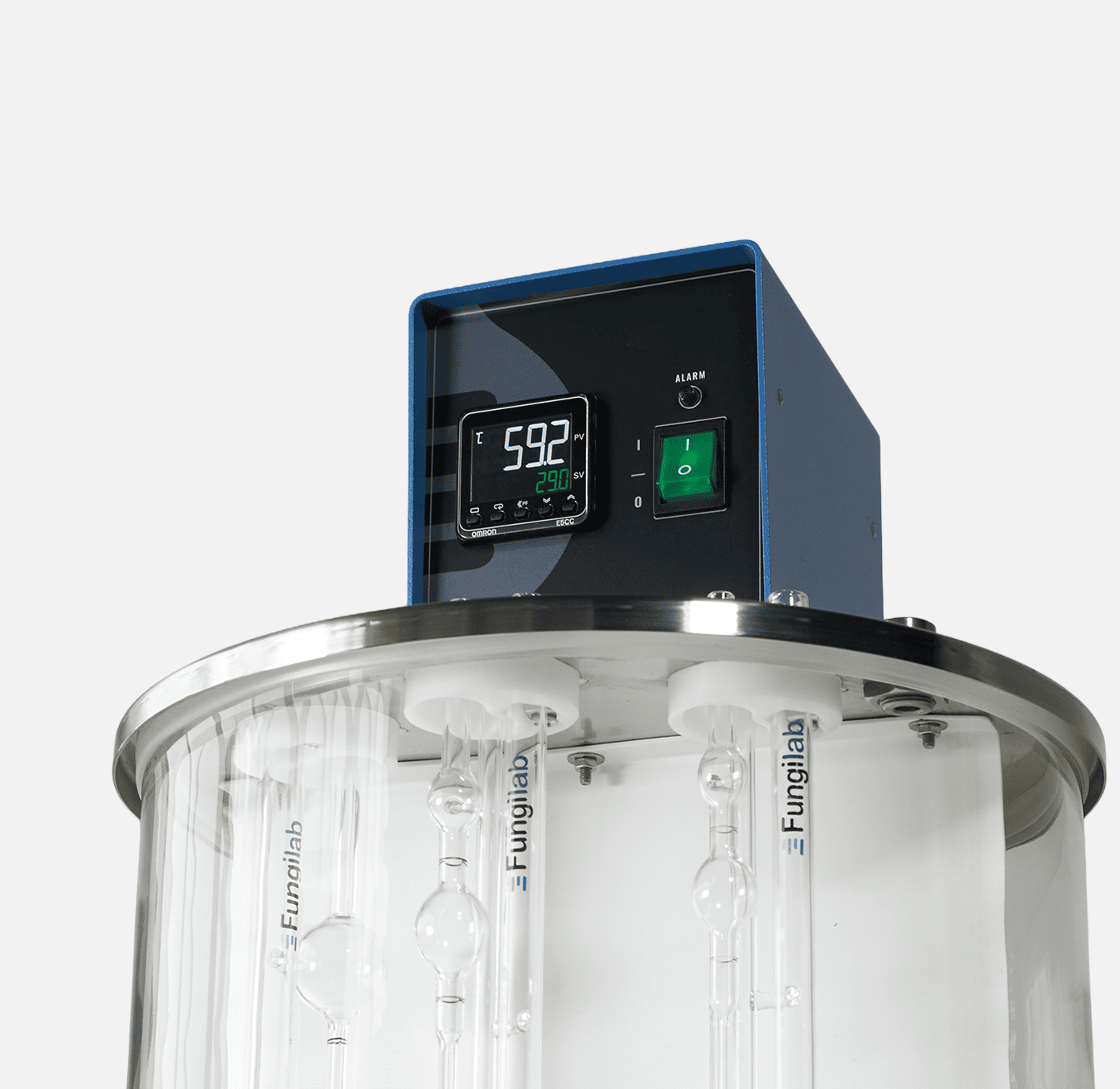
NOTE: The main body of the bath is made of a 20 liters borosilicate glass tank. A white plate is located at the back to help optimise and read the viscometers.
THERMOCAP
Kinematic viscosity products
Today’s business world brings new challenges that demand innovative solutions. Fungilab’s aim, as a leading viscosity technology company, is to become an expertise partner in the viscosity world to offer you our best products and services.
To provide you and your customers with this necessary attention and an expertise support, Fungilab offers a wide range of products for the measuring of the kinematic viscosity of your products.
Our kinematic series include: the Höppler viscometer (falling ball), for the measurement of the low viscosity liquids in all industries; capillary viscometer series and baths, in accordance to ASTM and DIN methods, to obtain the most accurate viscosity of your liquids; and flow cup viscometers, suitable for paints, inks, varnishes and similar products.
Kinematic viscosity is a measure of a fluid’s resistance to flow under the influence of gravity. It’s defined as the ratio of the fluid’s dynamic (absolute) viscosity to its density. In other words, it describes how thick or thin a fluid is without the involvement of any external force except gravity.
Precision temperature baths for capillary viscometers
A capillary viscometer bath is an essential part of any kinematic viscosity measurement system. Since viscosity is highly dependent on temperature, maintaining the sample at a constant temperature is critical for obtaining accurate and repeatable test results.
The Fungilab THERMOCAP has been developed specifically for laboratories performing kinematic viscosity measurements with glass capillary viscometers. Its precision temperature control helps laboratories comply with internationally recognised testing standards while improving measurement repeatability.
Designed for laboratory viscosity testing
THERMOCAP precision baths are suitable for use with the most common capillary viscometer designs, including:
- Cannon-Fenske Routine.
- Cannon-Fenske Opaque.
- BS/U-Tube viscometers for transparent liquids.
- BS/IP/RF U-Tube viscometers for opaque liquids.
- Ubbelohde viscometers.
Why temperature stability matters
Even small temperature variations can significantly affect kinematic viscosity values. A precision temperature bath ensures that every measurement is performed under controlled conditions, improving repeatability, reducing uncertainty and ensuring compliance with ASTM and ISO test methods.
Main advantages
- High temperature stability for viscosity testing.
- Excellent measurement repeatability.
- Suitable for multiple capillary viscometer types.
- Designed for laboratory quality control and research.
- Supports internationally recognised viscosity testing standards.
Complete kinematic viscosity solution
In addition to THERMOCAP precision baths, Fungilab supplies a complete range of glass capillary viscometers and laboratory accessories for kinematic viscosity measurement.
For instrument verification and calibration checks, laboratories can also use certified viscosity standard oils, providing confidence in measurement performance and long-term traceability.
Applications
Capillary viscometer baths are widely used in petroleum laboratories, lubricant manufacturers, chemical industries, research centres and quality control laboratories where precise kinematic viscosity measurements are required.
Frequently asked questions about Capillary Viscometer Bath
What is a capillary viscometer bath?
A capillary viscometer bath is a precision temperature-controlled bath used to maintain constant sample temperature during kinematic viscosity measurements with glass capillary viscometers.
Why is a temperature bath necessary for viscosity testing?
Kinematic viscosity is highly temperature-dependent. A precision bath ensures stable measuring conditions, improving accuracy, repeatability and compliance with testing standards.
Which capillary viscometers are compatible with THERMOCAP?
THERMOCAP is suitable for Cannon-Fenske Routine, Cannon-Fenske Opaque, BS/U-Tube, BS/IP/RF U-Tube and Ubbelohde glass capillary viscometers.
Which industries use capillary viscometer baths?
They are commonly used in petroleum, lubricant, chemical, pharmaceutical and research laboratories where precise kinematic viscosity measurements are required.
Can one bath be used with different capillary viscometers?
Yes. Precision viscosity baths are designed to accommodate multiple types of glass capillary viscometers, depending on the holder configuration.
Does temperature affect kinematic viscosity?
Yes. Even small temperature changes can alter viscosity values, making precise temperature control essential for obtaining reliable laboratory results.
Can THERMOCAP be used for ASTM viscosity testing?
Yes. THERMOCAP is designed to provide the temperature stability required for kinematic viscosity measurements performed according to internationally recognised ASTM and ISO methods.
How can the accuracy of capillary viscosity measurements be verified?
Measurement performance can be verified using certified viscosity standard oils together with properly calibrated glass capillary viscometers and a precision temperature bath.