PRODUCTS
Höppler viscometer
Höppler viscometers for precise viscosity measurement
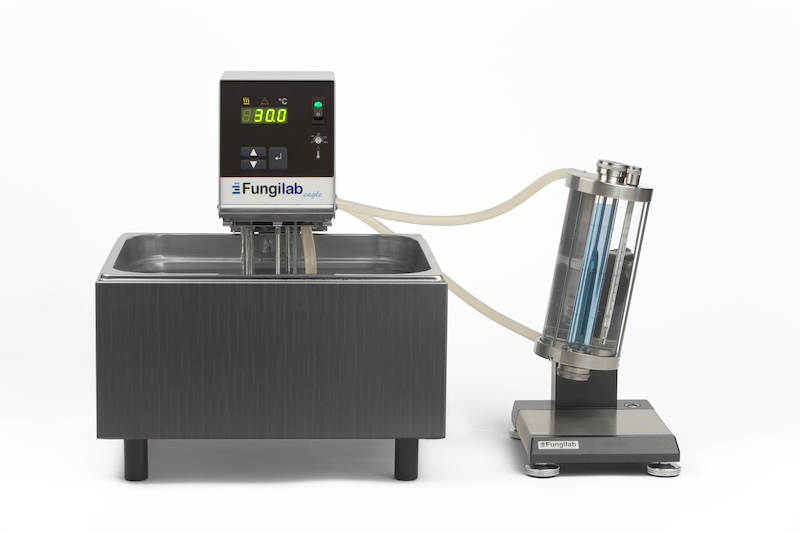
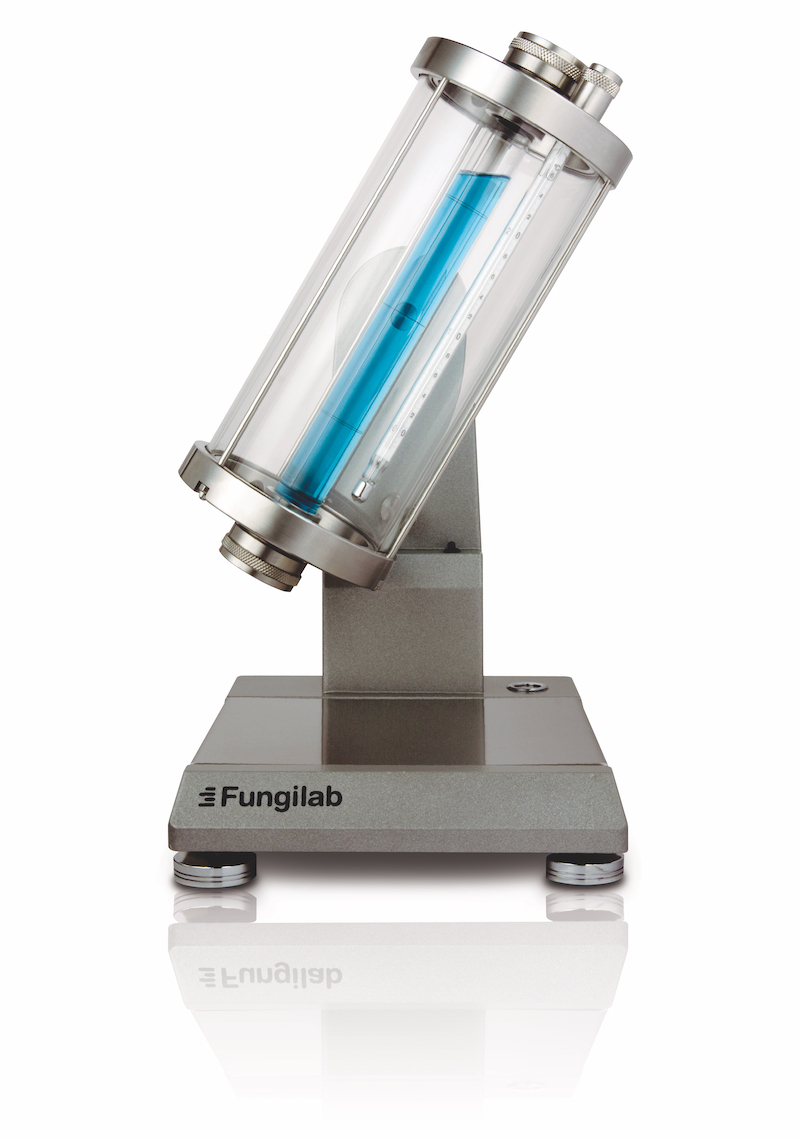
A Höppler viscometer, also known as a falling ball viscometer, measures the viscosity of transparent Newtonian liquids by determining the time required for a precision ball to travel through the sample under the influence of gravity.
This measurement principle provides highly accurate and repeatable viscosity determinations and is widely used in research laboratories, quality control and standards-based testing for low to medium viscosity liquids.
Fungilab offers a complete range of viscosity measurement solutions, including rotational viscometers and temperature control systems for laboratories requiring accurate, reliable and traceable viscosity measurements.
Our products
Kinematic Viscometer Types
Hoppler Viscometer (Falling Ball)
Measures accurately the viscosity of transparent Newtonian liquids and gasses (with a special glass ball)
Main Features
- High accuracy through improved visibility of the falling ball.
- Minimized test time due to accurate return run of the ball.
- Reduced cost of ownership through increased lifetime of falling tube.
- Extended re-calibration periods through improved bearing support.
The Viscoball viscometer is mainly used for low viscosity substances such as used in:
- Mineral oil industry (oils, liquid hydrocarbons, …).
- Food industry (sugar solution, beer, milk, gelatine, fruit juice, …).
- Chemical industry (polymer solutions, solvents, resin solutions, latex dispersions,
- adhesive solutions, …).
- Cosmetic/Pharmaceutical industry (raw materials, glycerine, emulsions, suspensions,
- solutions, extracts, …).
- Petroleum industry (light crude, machine oil, crude petroleum,…).
- Fuels (petrol, diesel oil, paraffin, …).
- Paper industry (emulsions, pigment dispersion, paper additives, …).
- Paints and varnishes (printing inks, varnishes, water lacquers, inks,…).
- Detergents (liquid washing agents, washing-up liquids, tenside solutions,…).
Measuring principle
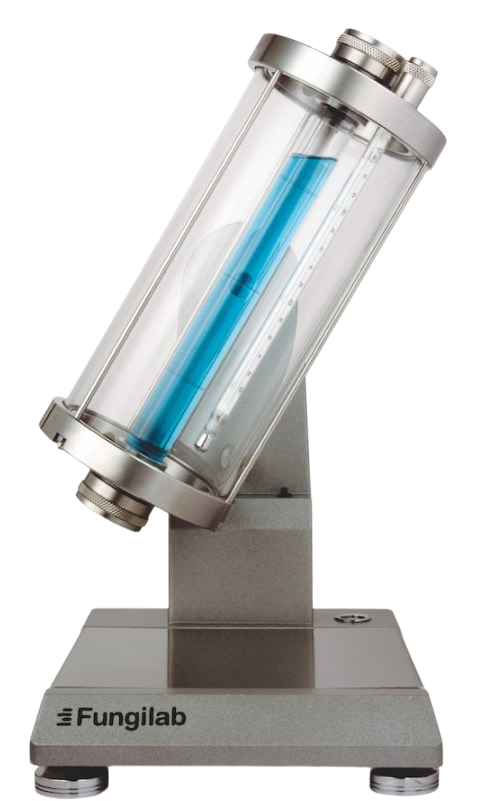
The rolling and sliding movements of a ball through the sample liquid are timed in an inclined cylindrical measuring tube. The sample viscosity is correlated to the time the ball requires to travel a defined distance. By turning the measuring tube upside down again the return of the ball may also be used for an additional measurement applying the return constant. The test results are given as dynamic viscosity in the internationally standardized, absolute units of mPa·s.
HOPPLER VICOMETER (Falling Ball)
Accessories
Today’s business world brings new challenges that demand innovative solutions. Fungilab’s aim, as a leading viscosity technology company, is to become an expertise partner in the viscosity world to offer you our best products and services.
To provide you and your customers with this necessary attention and an expertise support, Fungilab offers a wide range of products for the measuring of the kinematic viscosity of your products.
Our kinematic series include: the Höppler viscometer (falling ball), for the measurement of the low viscosity liquids in all industries; capillary viscometer series and baths, in accordance to ASTM and DIN methods, to obtain the most accurate viscosity of your liquids; and flow cup viscometers, suitable for paints, inks, varnishes and similar products.
Kinematic viscosity is a measure of a fluid’s resistance to flow under the influence of gravity. It’s defined as the ratio of the fluid’s dynamic (absolute) viscosity to its density. In other words, it describes how thick or thin a fluid is without the involvement of any external force except gravity.
Falling ball viscosity measurement for laboratory applications
The Höppler viscometer determines dynamic viscosity by measuring the time taken for a calibrated ball to move through a liquid-filled tube positioned at a defined angle. The falling time is directly related to the liquid's viscosity and is calculated using the instrument calibration constants.
This method is particularly suitable for transparent Newtonian liquids where highly accurate and reproducible viscosity measurements are required.
How a Höppler viscometer works
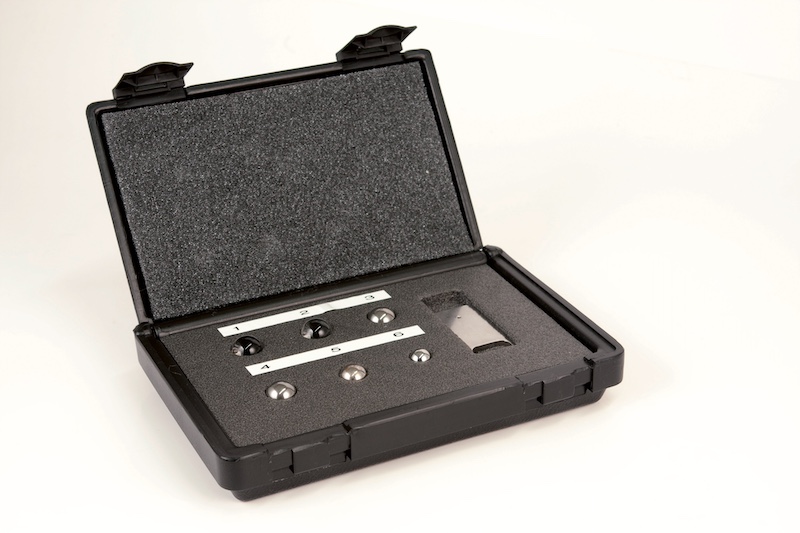
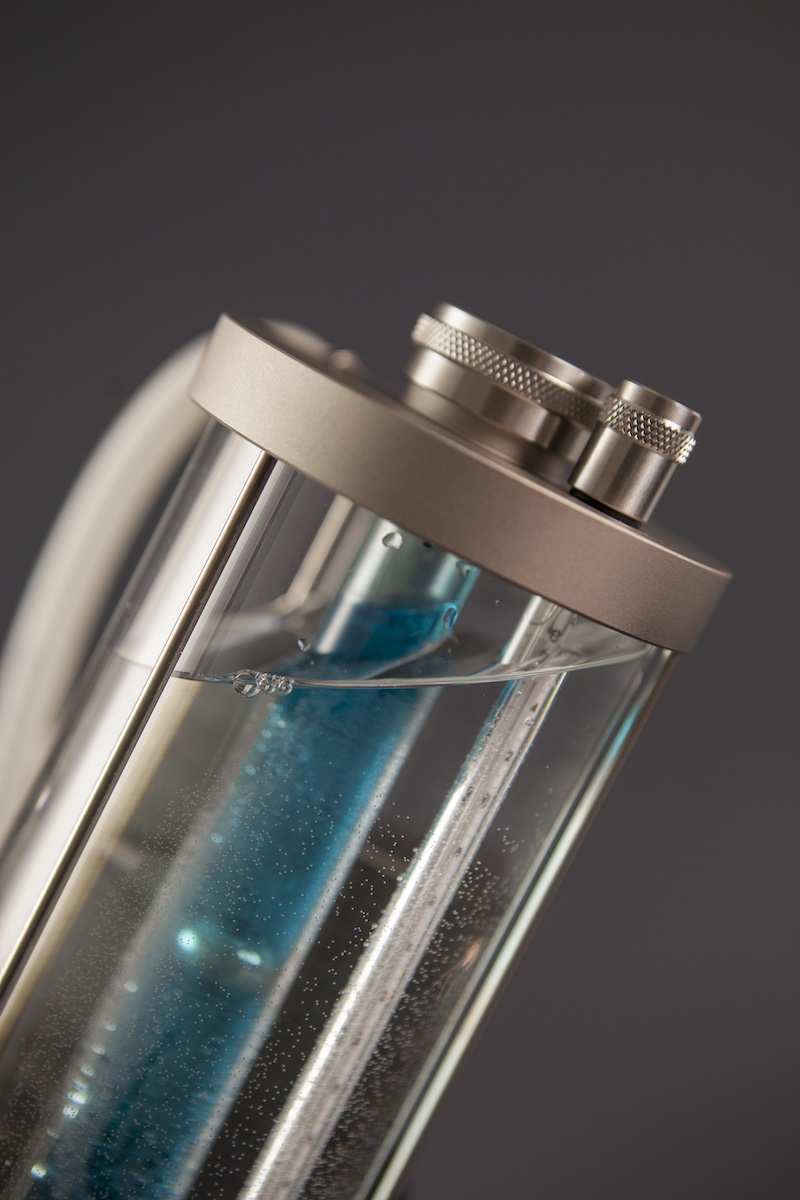
The instrument consists of a glass tube containing the test liquid and a precision ball with known dimensions and density. Under controlled temperature conditions, the ball falls through the sample and the transit time between two reference marks is measured. The viscosity is then calculated according to the instrument's calibration data.
Typical applications
- Pharmaceutical solutions.
- Chemical products.
- Industrial oils.
- Petroleum products.
- Solvents.
- Laboratory reference liquids.
- Research and development.
Importance of temperature control
Since viscosity is strongly influenced by temperature, Höppler measurements should always be performed under carefully controlled thermal conditions. Fungilab offers heating circulators and refrigerated circulators to maintain stable measurement temperatures.
Alternative viscosity measurement methods
Although Höppler viscometers are ideal for transparent Newtonian liquids, many industrial products exhibit non-Newtonian behaviour or require broader measuring capabilities. For these applications, Fungilab manufactures professional rotational viscometers, including the Viscolead Series and V-Series.
Instrument verification
To ensure long-term measurement reliability, laboratory instruments should be routinely verified using certified viscosity standard oils, helping maintain traceable and repeatable viscosity measurements.
Choosing the appropriate viscometer
The selection of a viscosity measurement method depends on the sample characteristics, viscosity range, transparency and testing requirements. Höppler viscometers are particularly suitable for transparent Newtonian liquids, while rotational viscometers provide greater flexibility for complex fluids and industrial formulations.
Frequently asked questions about Höppler viscometer
What is a Höppler viscometer?
A Höppler viscometer is a falling ball viscometer used to determine the dynamic viscosity of transparent Newtonian liquids by measuring the transit time of a precision ball through the sample.
Which liquids can be measured with a Höppler viscometer?
It is primarily intended for transparent Newtonian liquids such as oils, solvents, pharmaceutical solutions and laboratory reference fluids.
Why is temperature control important?
Viscosity varies with temperature, making precise thermal control essential for obtaining accurate and repeatable viscosity measurements.
How does a Höppler viscometer measure viscosity?
The instrument measures the time required for a calibrated ball to travel through the liquid under gravity, with the viscosity calculated from the measured transit time.
Can a Höppler viscometer measure non-Newtonian fluids?
It is mainly designed for Newtonian liquids. For non-Newtonian materials, rotational viscometers are generally the preferred solution.
Which industries use Höppler viscometers?
They are widely used in pharmaceutical, chemical, petroleum and research laboratories requiring highly accurate viscosity measurements.
How can measurement accuracy be verified?
Routine verification using certified viscosity standard oils helps maintain accurate, repeatable and traceable laboratory measurements.
When should a rotational viscometer be chosen instead?
Rotational viscometers are recommended for non-Newtonian fluids, wider viscosity ranges and applications requiring advanced viscosity analysis.