PRODUCTS
Dynamic viscosity
Our accessories
Enhance the capabilities of your Fungilab viscometer with accessories designed for more accurate, versatile and efficient viscosity measurements.
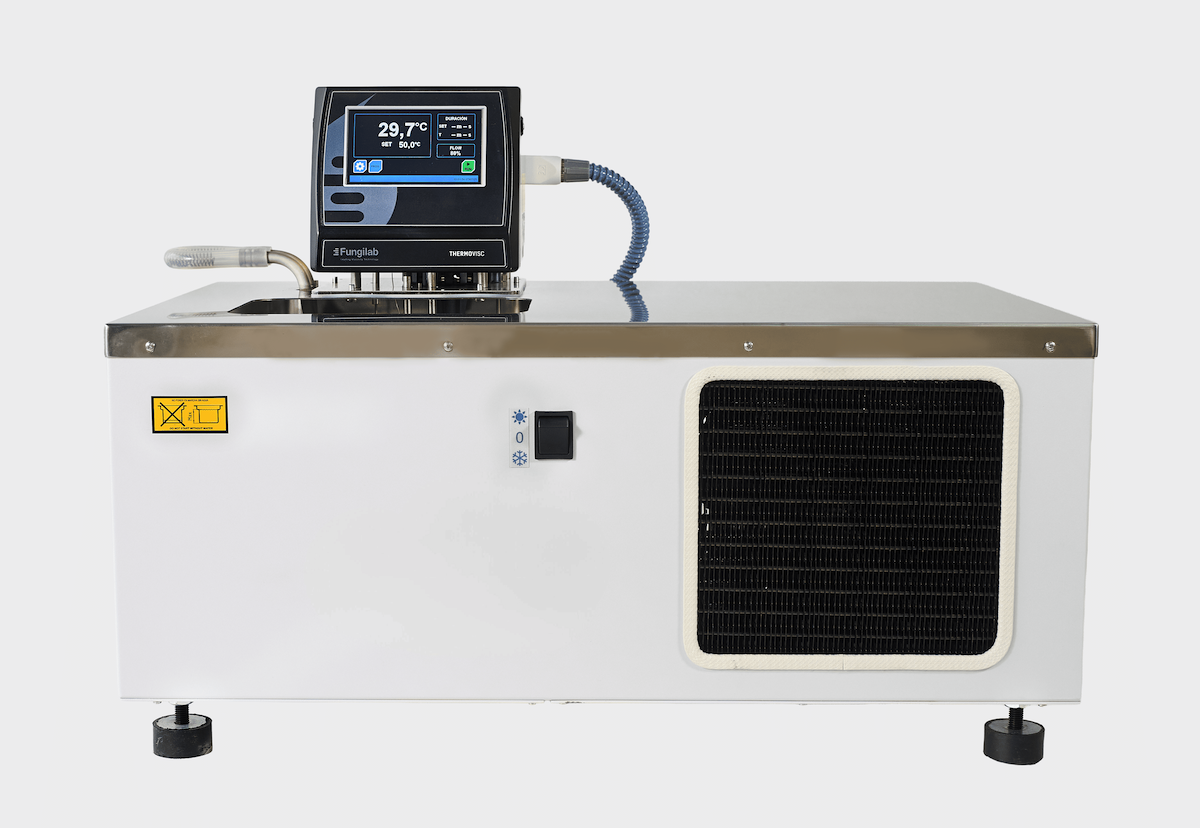
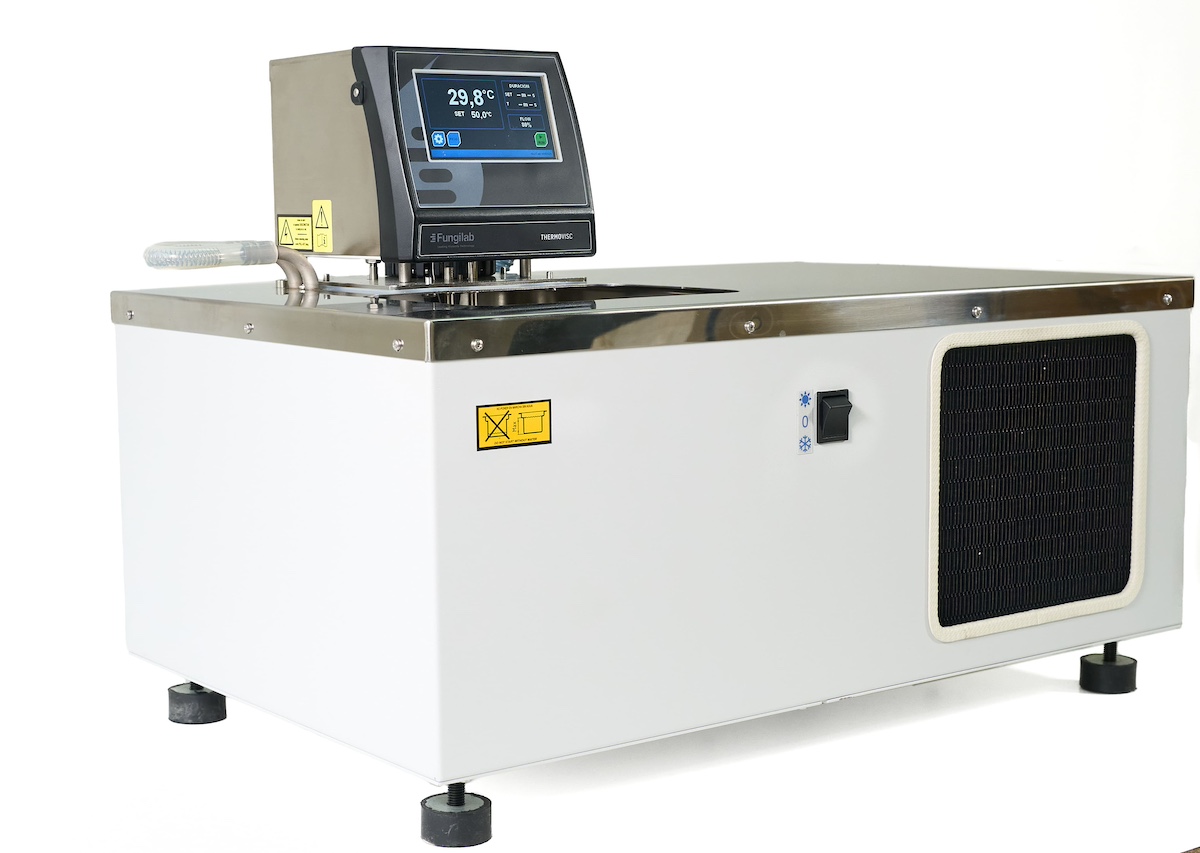
Refrigerated / Heating Circulator THERMOVISC B100F8TFT
ADJUSTABLE TEMPERATURE FROM -10°C TO 100°C.
FEATURES
• TFT Screen
• RS-232, USB and Ethernet output.
• Working volume 8l.
• AISI 304 stainless steel top and lid with an inner tank of AISI 304 stainless
Steel.
• Complete with pump for internal and external liquid circulation with push on
tube connectors for liquid and outlet.
• A drain tap is placed inside of the unit
• A hermetically sealed CFC compressor with a ventilated evaporator is
Mounted on anti-vibrations mounts.
NOTE: Also Available from -30°C TO 100°C. REF:B100F8TFT-30. Ask for more technical details to our general email admin@fgb-company.com.
LABORATORY DIVISION
Dynamic viscosity
Viscosity is part of the science of Rheology which quantifies the resistance materials give to changing shape.
Proper interpretation of viscosity data can reduce the rate of rejects while keeping production and formulation development costs to a minimum. Consistent product quality is ensured through proper viscosity measurements, either alone or in conjunction with compatible tests.
Dynamic viscosity testing can help with:
- Material characterization or “finger-printing”
- Standard testing methods to check for differences between batches
- Indirect way of measuring quality
- Product formulation
- Quality control
- Process control
- Design, optimization and operation of process equipment
Material characterization or “finger-printing”
Standard testing methods to check for differences between batches
Indirect way of measuring quality
Product formulation
Quality control
Process control
Design, optimization and operation of process equipment
Viscosity types
Dynamic viscosity
Centipoise (mPa*s)
Kinematic viscosity
Centistokes (mm2/sec)
Apparent viscosity
Centipoise (mPa*s)
Newton’s Law
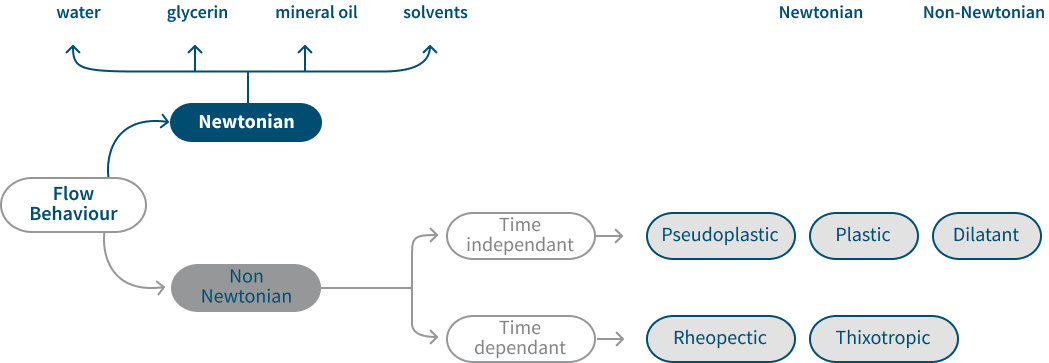
According to Newton’s law, the viscosity of a fluid is constant. As shear rate changes, shear stress changes in proportion such that viscosity is constant. Common fluids that exhibit such behavior are:
Unfortunately for us, not all fluids follow Newton’s law. In fact, most fluids do not. For this reason, fluids are classified into two categories:
Rotational Viscometer
The viscosity is calculated from the measured torque and rotational speed, as well as the dimensions of the measuring geometry.
A fluid’s resistance to flow is measured by the torque it exerts on the rotating shaft of the viscometer.
Absolute viscosity: the measuring geometry fulfills certain requirements (which is the case of coaxial spindles).
Relative viscosity: the dimensions of the measuring geometry are not well defined.
Advantage
Flexibility in:
- Viscosity Range
- Temperature range
- Shear rate range
Application
For Newtonian and non-Newtonian substances and temperatures different from room temperature.